







Operational Excellence in Motion: The Strategic Evolution of Mumbai’s Dabbawala Logistics Network
The Mumbai Dabbawala system represents one of the most sophisticated examples of supply chain management and logistical precision in the modern world. Operating in a city of over 20 million people, this network manages the daily collection, transport, and delivery of approximately 200,000 lunchboxes,and their subsequent return,with an error rate so low it has earned a legendary Six Sigma certification. What began in the late 19th century as a localized service to provide home-cooked meals to migrant workers has evolved into a global benchmark for operational efficiency. This report examines the evolution of the Dabbawalas’ identification systems, their integration with urban infrastructure, and the institutional resilience that sustains their unique business model.
The Evolution of Inventory Management and Identification Systems
At the heart of the Dabbawala success story is a robust, low-tech identification system that rivals modern digital tracking. In the early stages of the organization, sorting was managed through a rudimentary but effective system of colored threads. These threads served as visual cues, allowing workers,many of whom were semi-literate,to identify the destination and origin of each lunchbox (dabba) at a glance. This method relied on a shared cognitive map of the city’s geography, where specific colors corresponded to neighborhoods or railway stations.
As the volume of deliveries scaled, the complexity of Mumbai’s geography necessitated a more granular approach. The colored threads were eventually phased out in favor of a sophisticated alphanumeric coding system. This system, painted onto the lids of the dabbas, provides a comprehensive data set: the collection point, the starting station, the destination station, and the final building and floor number. This evolution mirrors the transition in global logistics from simple labeling to advanced barcoding. However, the Dabbawala system remains distinct because it requires zero electronic hardware, making it immune to power outages, software glitches, or cyber threats. The alphanumeric code acts as a decentralized database that every member of the network can read and execute instantaneously, ensuring that the “last mile” delivery is as accurate as the “first mile” collection.
Multimodal Logistics and the Backbone of Urban Infrastructure
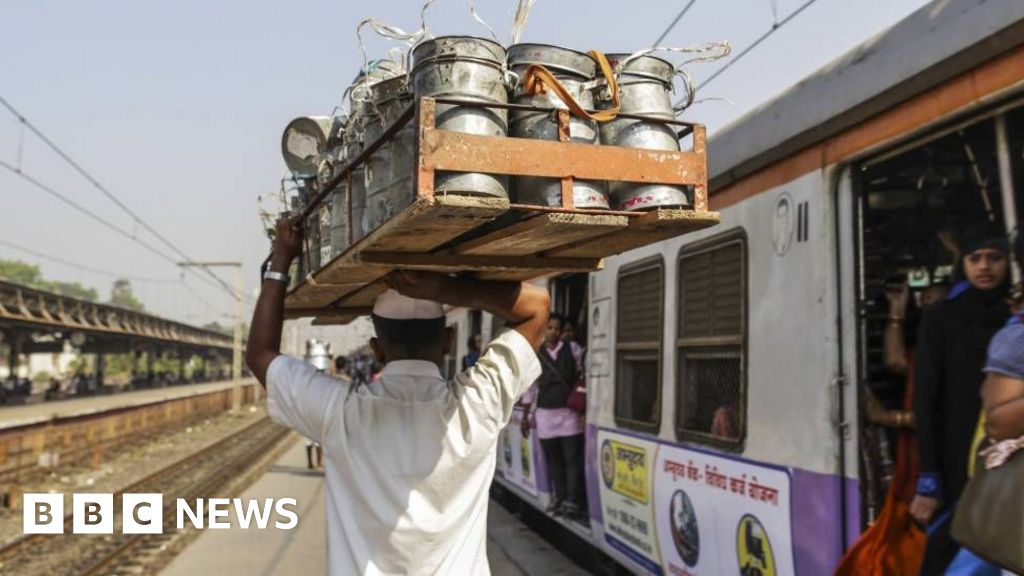
The Dabbawala business model is intricately woven into the fabric of Mumbai’s physical infrastructure. The process is a masterpiece of multimodal transport, utilizing bicycles, motorbikes, and the Mumbai Suburban Railway,often referred to as the city’s “lifelines.” The reliance on the suburban train network is a strategic masterstroke; it allows for the rapid transit of high volumes of goods across vast distances, bypassing the city’s notorious road congestion.

The workflow is divided into specific segments, creating a highly efficient relay system. The initial collection is usually performed on bicycles, which offer the agility needed to navigate narrow residential lanes. Once the dabbas reach the local railway stations, they are sorted and loaded onto wooden crates for transit in the luggage compartments of the trains. Upon reaching the destination station, another team of Dabbawalas takes over, often using motorbikes or hand-drawn carts for high-density commercial areas to ensure timely delivery before the lunch hour. This integration with public infrastructure not only minimizes capital expenditure but also aligns the organization with sustainable, low-carbon logistical practices. By leveraging the existing rhythm of the city, the Dabbawalas have created a high-velocity supply chain that is both cost-effective and environmentally responsible.
Institutional Resilience and Operational Excellence
Beyond the mechanics of transport and coding, the Dabbawala organization is a case study in human capital management and institutional resilience. The organization operates as a flat hierarchy, where every member is an equal shareholder in the association. This structure fosters a deep sense of ownership and accountability, which is the primary driver of their Six Sigma performance (an error rate of roughly 1 in 16 million deliveries). While most modern corporations rely on heavy investment in Enterprise Resource Planning (ERP) software to manage logistics, the Dabbawalas rely on a culture of discipline and time management.
The resilience of this system is tested daily by Mumbai’s extreme weather conditions, particularly the monsoon season. Despite torrential rains and flooding that often paralyze other sectors of the economy, the Dabbawalas rarely experience service interruptions. This reliability is built upon a decentralized management style where small groups of workers operate autonomously but in total synchronization with the larger network. Their ability to maintain such high standards without the use of mobile phones or digital coordination until very recently highlights a fundamental business truth: process and culture are often more critical to success than the technology used to implement them.
Concluding Analysis
The Mumbai Dabbawala system offers profound lessons for the modern corporate world, particularly in the fields of lean management and logistics. In an era where businesses are increasingly reliant on complex algorithms and expensive automation, the Dabbawalas demonstrate that simplicity and human-centric design can produce superior results. Their transition from colored threads to alphanumeric codes represents a logical progression toward data-driven decision-making, yet they have maintained the agility of a startup despite being over a century old.
From a strategic perspective, the Dabbawalas have successfully navigated the “last-mile delivery” challenge,a hurdle that continues to plague global e-commerce giants. By utilizing a relay system and public transit, they have optimized their cost structure while maintaining a level of precision that is the envy of supply chain experts worldwide. As urban centers become more crowded and the demand for personalized service grows, the Dabbawala model remains a timeless example of how organizational culture, when paired with a robust and simple process, can achieve a level of operational excellence that transcends technological limitations. The enduring success of this network serves as a reminder that the most effective solutions are often those that integrate seamlessly with the existing environment and prioritize reliability above all else.




